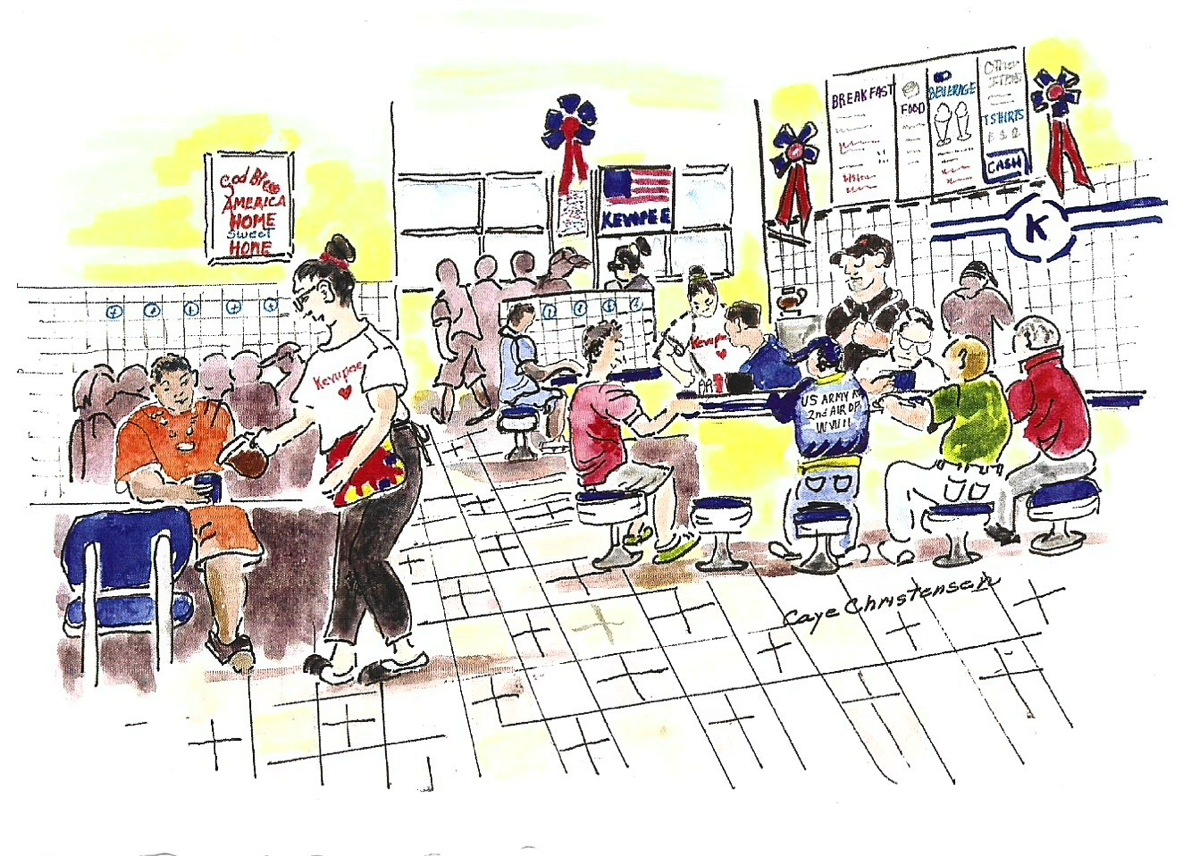
I’m sharing a gift from our Artist Alum, Caye Christensen (Putning) of the Great KEWPEE’S! Apparently we missed it by a year, but KewPees celebrates its 100th Anniversary in 2026. I imagine many of us from out of town had to make a trip there, while visiting for the 60th — I certainly did. And it was scrumptious.
A quick story…
My brother and I used to go downtown as kids for movies or the YMCA, etc. We would often go to Kewpee’s after. We waited awhile for someone to take our order, likely because we were kids (early teens and before), so my brother says, “Hey,” to get the attention of the cook. He turns around and says, “We don’t serve hay, here!” The Kewpee way at least in the good ol’ days!
Now-retired teacher compiles history of Horlick's song and its composer
TheJournalTimes.com|September 27, 2013 5:45 am • By Lee Roberts
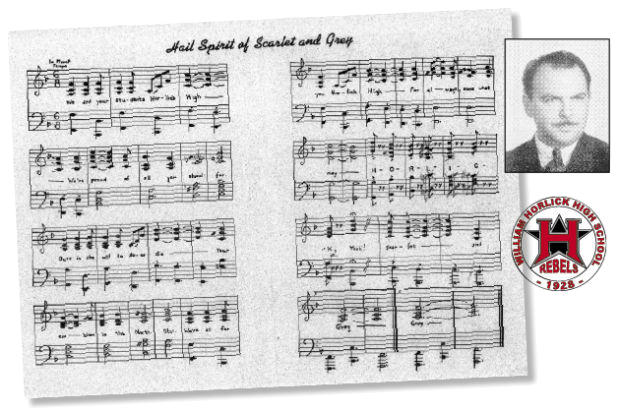
Max Plavnick was a young music teacher at William Horlick High School when he composed “Hail Spirit of Scarlet and Grey” — a song which has endured for 70 years as the school’s official song.
Plavnick — who was born in New York in 1909 and grew up in Racine — had joined Horlick’s faculty in 1937, after teaching for three years at McKinley Junior High School (as the city’s first male junior high teacher), according to Cindy Bononno Maragos. It was a few years later that Plavnick wrote Horlick’s song, which was actually the second official song written for the school.
The first song was composed by previous music teacher Lois M. Hanke Helding in 1934 and was called “We’re Loyal to You Horlick High School.” Both songs were used, for a while, on student radio programs broadcast on WRJN radio, Maragos said. But, after Horlick’s band made recordings of both in 1943, the student body voted to determine that the official school song would be Plavnick’s.
‘A really cool guy’
The story behind what today is called “The Spirit of Scarlet and Grey” (with slight word revisions) is one recently uncovered by Maragos, a now-retired Racine Unified School District physical education teacher.
While teaching at Horlick for the last eight years, Maragos also headed the school’s Graduates of Distinction program. And, in that capacity, she often prepared bits of historical information about the school and its students as gifts for alumni to take home from special events.
Maragos came across Plavnick’s name while poring through Horlick’s archives — which include every issue of “The Horlick Herald” student newspaper, and every yearbook since the school opened in 1928, according to Maragos. Plavnick was apparently a very popular teacher, she said, as many stories were written about him and his work with the band, as well as his school spirit.
“He sounds like a really cool guy,” said Maragos, who retired from Horlick in the spring and also taught at Park High School for 15 years. Plavnick served as a mentor to students, she said, and also gave his time to teach spinning to prospective drum majors/majorettes and serve as a cheerleading adviser.
Digging into history
The more that Maragos — a 1974 graduate of Horlick whose family is among the school’s earliest graduates — learned more about Plavnick, the deeper she dug for information. She found that while growing up here, Plavnick attended Franklin Junior High and graduated from the old Racine High School in 1927. He attended the University of Wisconsin-Madison, graduating in 1932 with majors in instrumental and vocal music. And went on to earn his master’s degree in music history and theory. Before coming back to Racine to teach, he taught for a couple years in River Falls.
Still, there were a lot of “missing pieces,” Maragos said. Why, for example, did Plavnick’s name just stop appearing in the “Herald” after a while? “It was like he just dropped out of sight,” she said.
Her curiosity led her to tap into ancestry.com — a popular genealogy website — where she found Plavnick’s son, Paul. “I typed in Plavnick and a few names came up,” she said.
Knowing it was a “long shot” she sent an email to a Paul Plavnick, and when she received a response from him the following day “his email just blew me away,” Maragos said.
Paul Plavnick was a young child when he and his family moved away from Racine, but he was able to answer Maragos’ question about where his father went, and confirm information she had gleaned from the archives. Max Plavnick left Horlick in 1947 to take a job as superintendent of music for the Ferguson-Florissant Public School District in Missouri, where he served until his death in December of 1966. In other words, Maragos said, he left for “greener pastures.” Paul Plavnick also confirmed Maragos’ assumption that his father was a “very fun man.”
Maragos told Paul Plavnick how his father’s legacy had endured with the school song, and she sent him copies of Horlick memorabilia. “The kids still sing his song at every game, every rally and every assembly,” she said.
A gift for alumni
She also tracked down Paul Krause, a Horlick alumni living on the West Coast who did the only revision of Plavnick’s score in 1956, while still a student. Krause’s arrangement was done to accommodate more instruments, Maragos explained. And, Maragos compiled all that she learned and has given the story as a gift to Horlick alumni, along with professionally printed copies of what she believes is Plavnick’s original score.
“It looks old, but we can’t be certain it is the original,” she said, adding that Plavnick’s son said he doesn’t have the original.
Her search for the music teacher’s story is one of quite a few Horlick-related subjects Maragos researched in her time at the school. She has enjoyed the “hunt” so much that she’s hoping to be able to continue her Horlick research, when she substitute teaches at the school.
“I just pick a topic and start digging,” she said. “This is my kicks.”
'Hail Spirit of Scarlet and Grey'
We are your students Horlick High.
We’re proud of all you stand for.
Ours is the will to do or die.
Your emblem is the ‘North Star’.
We’re all for you Horlick High, for always, come what may.
H-O-R-L-I-C-K, yeah! Scarlet and grey!
— written by Max Plavnick
Racine’s William Horlick High School2119 Rapids Drive, first opened in the fall of 1928, on 11 acres of land donated by William S. Horlick Sr. of Horlick’s Malted Milk Co.
The school celebrates its 85th birthday this year.
PETER JACKEL: Pinnow's shot remembered 50 years later
While it was not the Class of '65 that went to the state basketball tournament, we were in our sophomore year, when the Class of '63 did go. While I know we are well past this year's version of "March Madness," I thought it might not hurt to memorialize in our website the shot by Gary Pinnow heard round the State at that tournament. The Racine Journal Times recently remembered that shot of 50 years ago (Good grief, are we really that old???). Here's a copy of that article as reprinted from the newspaper...
Seventeen years before Al Michaels exuberantly asked his gasping audience whether they believed in miracles, Andy Shovers witnessed one that also has withstood the passing of time.
It was March 14, 1963 and Shovers, a Horlick High School sophomore at the time, was among 12,898 energized fans seated in the University of Wisconsin Field House at Madison. Horlick was playing in the state boys basketball tournament for just the second time since 1930 — two years after the school opened — but no way was it going to stick around for long.
Just six weeks earlier, the Rebels were 4-7 in the Big Eight Conference after a second close loss to Park. As for Milwaukee North, Horlick’s quarterfinal opponent, it was 23-0, ranked No. 1 in the state and loaded with some of the most elite talent in the state.
“They had beaten most of their opponents by large margins,” said Shovers, an attorney for the law firm Smith, Gambrell & Russell, LLP in Atlanta. “Their coach had them do a Globetrotter-type routine during warmups, which intimidated their opponents to the point they were beaten before the game started.”
Remarkably, though, Jack Belden’s Rebels stayed with this juggernaut. And then Gary Pinnow, a senior guard for Horlick who would be named Racine’s City Player of the Year that season, earned a permanent, prominent place in this county’s sports heritage.
Wilbert Fair made a long jump shot with 13 seconds left in the second overtime to put North up 50-49. And then the late Steve Klimek frantically passed to Pinnow, who dribbled to the opposite side of the circle and swished a twisting
18-foot jumper at the buzzer as stunned fans erupted in hysteria.
“Pinnow’s shot might have been the biggest single moment in Racine County sports history,” said Shovers, who has lived in Atlanta for 44 years. “It has to be the most exciting. North was considered unbeatable.
“The field house erupted when the shot went in. I have been fortunate to attend many exciting sports events over the years, but that moment remains the best and most thrilling.”
The magic ended that night for Horlick, which went on to lose to eventual champion Manitowoc in the semifinals and Eau Claire in the third-place game. But the moment lives on after a half century.
Quite simply, Pinnow might be this county’s version of Bobby Thomson, whose walkoff home run for the New York Giants in a 1951 playoff game against the Brooklyn Dodgers endures as one of the signature moments in sports history.
Just as the Giants didn’t go on to win the World Series, Horlick also didn’t capture the ultimate prize. But just as we remember Thomson for his “shot heard ’round the world,” we also remember Pinnow.
And as the 50th anniversary of Pinnow’s feat approaches — it’s Thursday, which is also the day of the week he made his famous shot — he pensively reflected on the fleeting few seconds that defined his life.
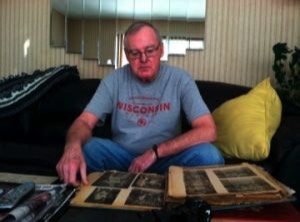
Wearing a gray Wisconsin T-shirt in the William Street home he has shared for the last 28 years with Kathy Vinnes, the 67-year-old Pinnow is somewhat feeble. He suffers memory lapses from a stroke he suffered in early 2012 and only recently found relief from unrelenting back misery with a pain pump.
But there was no forgetting his moment.
“There were five seconds left and they got the ball to me at midcourt,” Pinnow said. “I was going to go the right because that’s the way I normally dribbled, but all the players were in that area.
“So I went to my left and, at about the top of the key, I took a fadeaway jump shot and it was all net.”
All but lost in history is the story behind Horlick’s late-season revival. Pinnow won’t go into specifics, but he insists the Rebels started rolling after he got into a fist-fight with a teammate in the snow on the east end of Horlick just before practice.
The issue? A girl.
“We got into a fight over it, he got kicked off the team and, from then on, we just seemed to click,” Pinnow said. “The team thought, ‘We lost one of our good players and we’re going to have to make up for it.’ ”
Obscured by Pinnow’s heroics is that he is one of the finest athletes in this county’s history. He earned nine letters at Horlick, went on to be a defensive back and kicker for the Wisconsin football team and played baseball with George Foster and Steve Stone in the San Francisco Giants’ farm system in 1969. He also once averaged 290 as a bowler, was a 12-handicap golfer and played on seven straight city softball championships in Racine during the 1970s.
But what endures more than anything is “the shot.”
“I think people my age who read the sports section remember that shot and I think they always will,” Pinnow said.
Seventeen years before Al Michaels exuberantly asked his gasping audience whether they believed in miracles, Andy Shovers witnessed one that also has withstood the passing of time.
It was March 14, 1963 and Shovers, a Horlick High School sophomore at the time, was among 12,898 energized fans seated in the University of Wisconsin Field House at Madison. Horlick was playing in the state boys basketball tournament for just the second time since 1930 — two years after the school opened — but no way was it going to stick around for long.
Just six weeks earlier, the Rebels were 4-7 in the Big Eight Conference after a second close loss to Park. As for Milwaukee North, Horlick’s quarterfinal opponent, it was 23-0, ranked No. 1 in the state and loaded with some of the most elite talent in the state.
“They had beaten most of their opponents by large margins,” said Shovers, an attorney for the law firm Smith, Gambrell & Russell, LLP in Atlanta. “Their coach had them do a Globetrotter-type routine during warmups, which intimidated their opponents to the point they were beaten before the game started.”
Remarkably, though, Jack Belden’s Rebels stayed with this juggernaut. And then Gary Pinnow, a senior guard for Horlick who would be named Racine’s City Player of the Year that season, earned a permanent, prominent place in this county’s sports heritage.
Wilbert Fair made a long jump shot with 13 seconds left in the second overtime to put North up 50-49. And then the late Steve Klimek frantically passed to Pinnow, who dribbled to the opposite side of the circle and swished a twisting
18-foot jumper at the buzzer as stunned fans erupted in hysteria.
“Pinnow’s shot might have been the biggest single moment in Racine County sports history,” said Shovers, who has lived in Atlanta for 44 years. “It has to be the most exciting. North was considered unbeatable.
“The field house erupted when the shot went in. I have been fortunate to attend many exciting sports events over the years, but that moment remains the best and most thrilling.”
The magic ended that night for Horlick, which went on to lose to eventual champion Manitowoc in the semifinals and Eau Claire in the third-place game. But the moment lives on after a half century.
Quite simply, Pinnow might be this county’s version of Bobby Thomson, whose walkoff home run for the New York Giants in a 1951 playoff game against the Brooklyn Dodgers endures as one of the signature moments in sports history.
Just as the Giants didn’t go on to win the World Series, Horlick also didn’t capture the ultimate prize. But just as we remember Thomson for his “shot heard ’round the world,” we also remember Pinnow.
And as the 50th anniversary of Pinnow’s feat approaches — it’s Thursday, which is also the day of the week he made his famous shot — he pensively reflected on the fleeting few seconds that defined his life.
Wearing a gray Wisconsin T-shirt in the William Street home he has shared for the last 28 years with Kathy Vinnes, the 67-year-old Pinnow is somewhat feeble. He suffers memory lapses from a stroke he suffered in early 2012 and only recently found relief from unrelenting back misery with a pain pump.
But there was no forgetting his moment.
“There were five seconds left and they got the ball to me at midcourt,” Pinnow said. “I was going to go the right because that’s the way I normally dribbled, but all the players were in that area.
“So I went to my left and, at about the top of the key, I took a fadeaway jump shot and it was all net.”
All but lost in history is the story behind Horlick’s late-season revival. Pinnow won’t go into specifics, but he insists the Rebels started rolling after he got into a fist-fight with a teammate in the snow on the east end of Horlick just before practice.
The issue? A girl.
“We got into a fight over it, he got kicked off the team and, from then on, we just seemed to click,” Pinnow said. “The team thought, ‘We lost one of our good players and we’re going to have to make up for it.’ ”
Obscured by Pinnow’s heroics is that he is one of the finest athletes in this county’s history. He earned nine letters at Horlick, went on to be a defensive back and kicker for the Wisconsin football team and played baseball with George Foster and Steve Stone in the San Francisco Giants’ farm system in 1969. He also once averaged 290 as a bowler, was a 12-handicap golfer and played on seven straight city softball championships in Racine during the 1970s.
But what endures more than anything is “the shot.”
“I think people my age who read the sports section remember that shot and I think they always will,” Pinnow said.
Some Racine historical perspectives…
> Penny Postcards
> Wisconsin Web Archives— Racine County
> Archive Index for Racine
CATCHING UP WITH COACH JERRY FISHBAIN
Jerry Fishbain offers a glorious voice from the past
PETER JACKEL peter.jackel@journaltimes.com Sep 9, 2018
The Jerry Fishbain File | BORN: Nov. 30, 1932 in Racine
HIGH SCHOOL: Horlick '51 | COLLEGE: UW-La Crosse '55 | RESIDENCE: Madison

Jerry Fishbain compiled a 47=23=1 record as Horlick football coach from 1961-69. His 1967 team shut out six opponents, which remains the only Horlick team undefeated and untied in a season.
FAMILY: Fishbain and his wife, Janet, were married in 1966. They are the parents on son Jason, 49, and daughters Sarah, 47, and Rachel, 44. The Fishbains have three grandchildren.
AT HORLICK: After serving in the United States Army from 1955-57, Fishbain joined Horlick's faculty. He succeeded Jack Belden as football coach in 1961 and went on to compile a 47-23-5 record through nine seasons. His 1967 team, which shut out six opponents, remains the only team in Horlick's history to finish a season with no losses or ties. The 1968 team shut out five teams and scored the most points (231) in the program's history at that point.
The voices from a bygone sports era in Racine County are gradually fading away. Jim Thompson. Eddie Race. John McGuire. Jack Belden. Owen Evans. Don Schutt. Willie Eickhorst. Gene Veit. And the list continues to get longer with the passing of time.
Yet, there is one voice that resonates even as he approaches his 86th birthday in November. His name is Jerry Fishbain and, a half century ago, he was nearing the end of a glorious nine-year run as coach of the Horlick High School football team.
Fishbain was Vince Lombardi-esque in that he was a tough coach with a “my-way-or-the-highway” mindset. He became Horlick’s coach in 1961, two years after Lombardi arrived in Green Bay, and left after the 1969 season, two years after Lombardi stepped down as Packers coach.
From a high school perspective in this county, Fishbain’s nine years at Horlick very much were comparable with Lombardi’s nine years in Green Bay in terms of impact.
He took over a team that had won one game in 1960 and was named the Big Eight Conference Coach of the Year after guiding the Rebels to a 4-2-1 record his first season.
Fishbain’s 1964, ‘66, and ‘67 teams won at least a share of the conference championship. And that ‘67 team remains the only season in the program’s history in which Horlick players turned in their equipment at the end of the season without a loss or tie (remember, this was long before the days of the state playoffs).
The traditional season-ending showdown between Horlick and Park used to draw close to 10,000 fans in those days. Fishbain said he once heard that a line to get into Horlick Field for a Park-Horlick game stretched all the way south to Island Park.
It was a remarkable era in the history of high school sports in this county. And Fishbain was a giant throughout his run at Horlick.
“He was so smart and he was so intellectually in tune with everything,” said Mike Reinfeldt, a former NFL cornerback and executive with the Packers who played under Fishbain at UW-Milwaukee in the early 1970s. “And he was just a master of coordinating and getting these huge young football players to do whatever he wanted them to do. He intellectually managed everything. It was fun to watch him.”
Nine seasons to remember
Fishbain, who lives in Madison with his wife of 52 years, Janet, remembers those nine years with fondness. His only two requests for this interview were to focus on his years at Horlick and to not be asked about specific players because he didn’t want to single out anyone.
“We were very organized and disciplined on the practice field,” Fishbain said when asked about that dramatic turnaround in 1961. “It was a group that wanted to do it.
“They got involved in weights, which they hadn’t done before, they got involved in a little bit of training ... there was a tremendous nucleus of guys. Any of our success — and this isn’t false modesty — is that I had some fine assistant coaches and they worked their butts off. And they wanted to work with young people.”
But as modest as he comes across all these years later, Fishbain concedes that, “I went to every football clinic that I could and I read every book that I could. One of the great books I read was by Woody Hayes and I patterned a number of things I did after him.”
Fishbain was old-school tough in those days — “there was never any back talk on the practice field or in meetings,” he said — and there are some things he did that he regrets. One of the biggest was not allowing a senior who wanted to try football for the first time to join the team.
“Life should be an adventure,” Fishbain says now. “That was a big mistake not letting them play.”
But under Fishbain’s leadership, Horlick enjoyed one if its greatest eras. The ‘64 team was deprived of a perfect season only by a season-ending 20-20 tie to Park before an estimated crowd of 9,500.
In 1966, the Rebels had to settle for a co-conference championship with Madison West after getting edged 14-13 by Park before an estimated crowd of 10,000.
The peak season
And then came 1967.
Dave Morgan returned an interception 12 yards for a touchdown and Horlick defeated Park before an estimated crowd of 6,500 Nov. 10, 1967. The Rebels, who shut out six opponents that season, finished 9-0 overall and 8-0 in the conference for their only perfect season to date.
How emotional was the Horlick-Park rivalry in those days? Consider this story from Fishbain from when Horlick defeated Park 20-6 in 1968.
“We were winning by two touchdowns and we were going in to score again,” he said. “I called time out and said to the second-team quarterback, ‘You take a knee. We’re not going to go for it.’ And I got so much criticism from the Horlick people — even friends! They were saying, ‘Why would you do that?’ And I said, ‘Wait a minute!’ “
But Fishbain’s run at Horlick was destined to end on an unhappy note when the Rebels slipped to 2-7 in 1969. While Fishbain declined to get specific about what happened that year, he made clear that a number of factors were involved in that collapse.
“We didn’t get out a number of kids who had been out previously,” he said. “And I made personnel changes I should not have made. I lost my patience, which I should not have and I didn’t interact well with the assistants.
“There were other things going on that I was angry about with what was happening in the building and I let that bother me. That was no excuse.”
Moving on to UW-Milwaukee
Fishbain left Horlick in 1970 to work on an advanced degree at UW-Milwaukee, where he joined the football staff (the school dropped its football program after the 1974 season). He was head coach of the Panthers in 1971 and ‘72 and his players included Reinfeldt and quarterback Bill Carollo, who would go on to officiate in two Super Bowls and become Director of Officiating for the Big Ten Conference in 2008.
In 1972, Fishbain led UWM to six victories, its most since 1933.
Fishbain, who was also athletic director at UWM from 1973-75, was just getting started. He moved on to UW-River Falls, where he was defensive coordinator and then to the University of Minnesota, where he was recruiting coordinator.
He was hired at Wisconsin by the late Dave McClain in 1980, where he served as recruiting coordinator until getting fired by Don Morton in 1987. Barry Alvarez brought back Fishbain in 1990 for a newly-created post in which Fishbain served as a liaison between the football program and the academic support staff.
Fishbain retired in 2000 with a remarkable record of success.
“I’ve been very fortunate, very fortunate,” Fishbain said. “I married a wonderful woman and have children and grandchildren. Hey, I ended up being around Division III, Division II and Division I.
“I’ve been very fortunate.”

Dan & Jan White were in Honolulu for the UW/U of Hawaii game on Nov. 25, 2005. Notice their custom “W” aloha shirts! The Badgers won (of course) 41-24. The Whites are shown with KT and her brother Karl Haase (Horlick ’67).
If any questions or comments, please send me an email via the contact below…